
The Kelpies of Falkirk: Myth, Muscle, and the Canals That Shaped a Nation
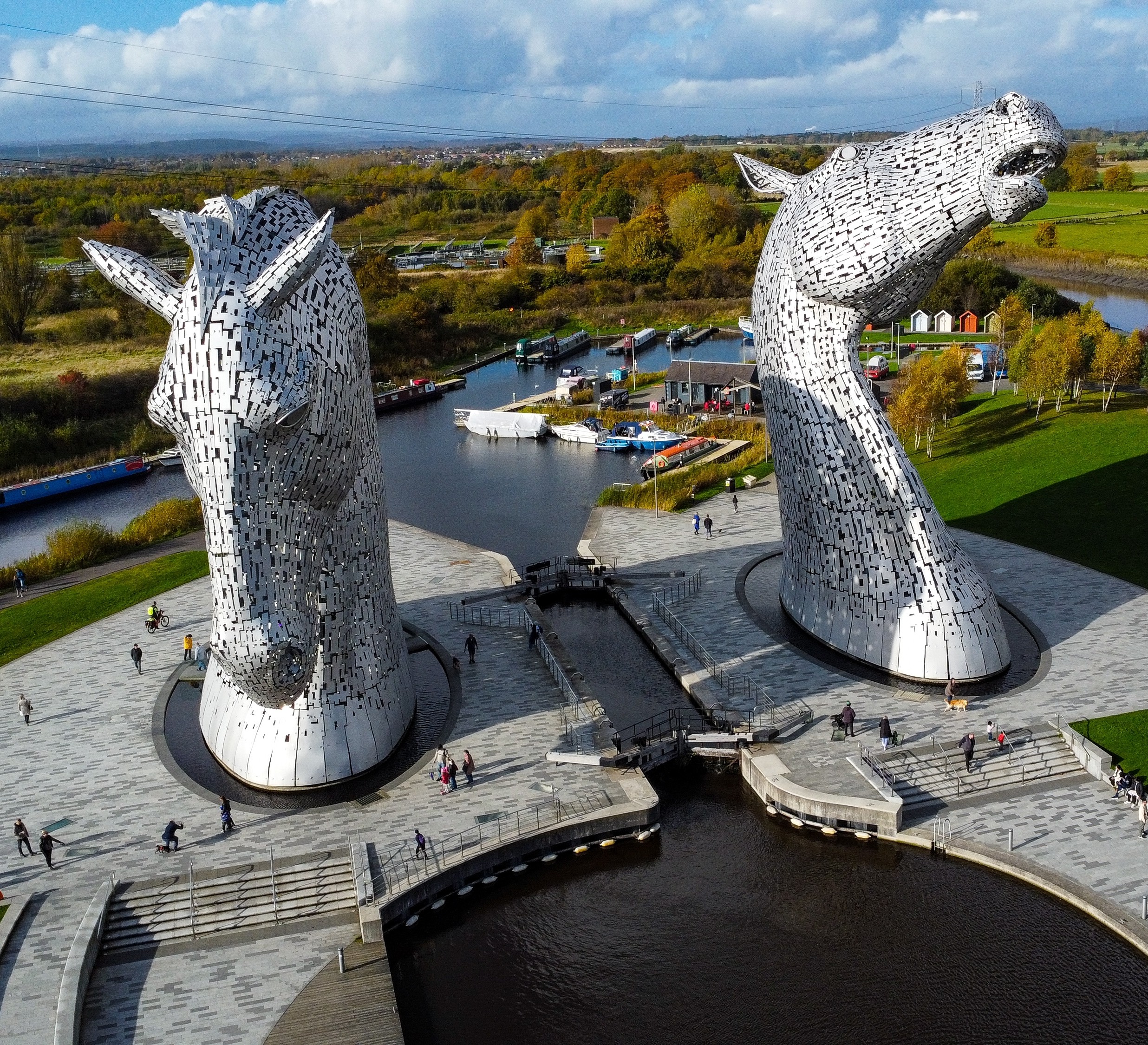
Standing beside the waterways at The Helix in Falkirk, The Kelpies rise dramatically from the landscape, their towering steel heads instantly commanding attention. At 30 metres high, these monumental sculptures have become one of Scotland’s most recognisable modern landmarks, yet their story is deeply rooted in centuries of history, engineering, and the vital role Falkirk has played within Scotland’s canal network.
Completed in 2013, The Kelpies were created by Scottish sculptor Andy Scott as part of a major regeneration project intended to reconnect surrounding communities with green spaces and the historic canals that pass through the area. The name comes from Scottish folklore, where kelpies were mythical water spirits, often appearing as powerful horses associated with rivers and lochs. While the sculptures draw on myth, they are equally a tribute to real working horses, whose strength once drove agriculture, industry, and transport across central Scotland.
The horse has long been a symbol of power and labour, and nowhere was that power more evident than along Scotland’s canals. Before the arrival of railways and motor transport, heavy horses were essential for hauling barges along towpaths, moving coal, iron, timber, and other goods that fuelled the Industrial Revolution. Falkirk, positioned at the narrowest crossing point of Scotland, became a natural hub for this movement of goods, and its landscape was transformed by canals designed to link east and west.
The Forth and Clyde Canal, opened in 1790, created a direct navigable route between the River Forth and the River Clyde, allowing vessels to cross the country without the long and hazardous journey around the northern coast. Later, in 1822, the Union Canal was completed, linking Falkirk with Edinburgh. Built without locks and maintained at a constant level, it relied on an ingenious system of aqueducts and cuttings to cross the terrain. Together, these waterways formed a vital transport corridor that supported industry and commerce for generations.
The design and construction of The Kelpies echo this industrial heritage. Each sculpture is built around a complex steel framework, clad in thousands of uniquely shaped stainless-steel plates. One head is calm and steady, while the other twists with energy, reflecting both controlled strength and raw power. The materials and engineering methods deliberately reference the heavy industry and foundry work that once dominated Falkirk, bridging the past and the present in a single, striking form.
As industrial transport declined during the twentieth century, Scotland’s canals fell into disuse, with sections closed or filled in. One of the most significant challenges in their restoration was the 35-metre height difference between the Forth and Clyde Canal and the Union Canal, a gap once managed by a flight of locks that had been dismantled in the 1930s. The modern solution to this problem was the Falkirk Wheel, opened in 2002.
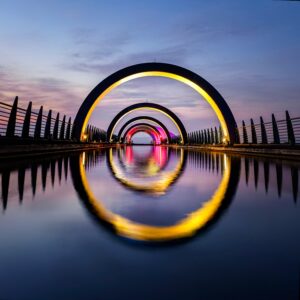
The Falkirk Wheel is the world’s only rotating boat lift and stands as a remarkable example of contemporary engineering. Rather than using a staircase of locks, the Wheel lifts boats between the two canals by rotating two water-filled caissons in perfect balance. Thanks to the principle of displacement, each caisson weighs the same whether it carries a boat or not, allowing the entire structure to rotate using surprisingly little energy. The Wheel not only reconnects the canals but has become an international symbol of innovation and design.
Today, the canals around Falkirk are once again alive with activity, though their purpose has changed. Where working barges once carried heavy cargo, leisure boats now cruise the waterways, while towpaths serve walkers and cyclists. Wildlife has returned, and the canals have become valuable green corridors through the urban landscape. The Kelpies and the Falkirk Wheel together form the centrepiece of this revival, drawing visitors from across the world and reinforcing the area’s identity as a place shaped by water, engineering, and imagination.
Though unmistakably modern, The Kelpies are firmly grounded in history. They stand as guardians of Falkirk’s waterways, celebrating the muscle power that once drove Scotland’s industry, the ingenuity of canal engineers, and the enduring relationship between people, horses, and water. In doing so, they connect ancient folklore with industrial achievement, ensuring that the story of Scotland’s canals continues to be told in a bold and unforgettable way.
When you click on links to merchants from the site Website and make a purchase it may lead to this website earning a commission. This does not effect the price you pay. Affiliate programs and affiliations include but are not limited to The Ebay Partner Network, Amazon, and Awin programs.