

Britain’s two great boat lifts: Victorian grit vs Millennium flair
The UK only has two working canal boat lifts, and they couldn’t feel more different. One is a raw piece of Victorian industrial muscle, the other a sleek 21st-century engineering icon. Yet both solve the same age-old problem: how to move boats vertically between waterways without wasting time or water.
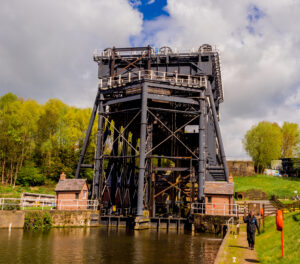
Anderton Boat Lift — the original “Cathedral of the Canals”
Built in 1875, the Anderton Boat Lift was the world’s first major commercial boat lift. Its job was brutally practical: link the Trent & Mersey Canal with the River Weaver, 50 feet below, to speed up the transport of salt and other industrial goods.
Before it existed, cargo had to be laboriously transferred between waterways. The lift eliminated that bottleneck—essentially acting as a vertical shortcut during the height of Britain’s industrial boom.
How it works (and why it struggled)
- Originally hydraulic, using giant water-filled pistons
- Later converted (1906–08) to an electric counterweight system to reduce maintenance headaches
- Eventually fell victim to its biggest enemy: corrosion
By 1983, the structure was deemed unsafe and shut down. It wasn’t until a major restoration—funded by heritage bodies and public support—that it reopened in 2002 as both a working lift and visitor attraction.
Even today, it’s often called one of the “Seven Wonders of the Waterways”—a testament to just how ambitious Victorian engineers were.
Falkirk Wheel — the world’s only rotating boat lift
Jump forward over a century, and you get something completely different.
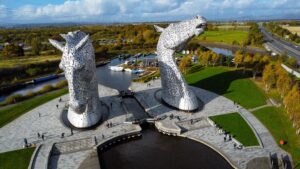
Opened in 2002, the Falkirk Wheel was built as part of the Millennium Link project to reconnect Scotland’s long-broken canal network between Glasgow and Edinburgh.
Instead of rebuilding a flight of 11 traditional locks (which took hours and vast amounts of water), engineers designed a rotating wheel that lifts boats 24 metres in one smooth motion.
Why it’s so clever
- Uses Archimedes’ principle—each gondola stays balanced because displaced water equals the boat’s weight
- Needs surprisingly little power—about 18 kW, roughly comparable to a handful of household appliances
- Designed as both infrastructure and a landmark—part engineering, part sculpture
It’s the only rotating boat lift of its kind anywhere in the world.

Similar problem, wildly different solutions
At their core, both lifts exist for the same reason:
moving boats efficiently between waterways at different heights.
What they share:
- Both connect major canal systems
- Both eliminate the need for long lock flights
- Both reopened (or opened) in 2002, symbolically linking past and present
- Both are considered landmark feats of engineering
Where they differ:
| Feature | Anderton Boat Lift | Falkirk Wheel |
|---|---|---|
| Era | Victorian (1875) | Modern (2002) |
| Mechanism | Vertical caissons (hydraulic → electric) | Rotating wheel |
| Purpose | Industrial freight (salt trade) | Regeneration + tourism |
| Style | Functional, heavy ironwork | Sculptural, futuristic |
| Energy use | Mechanical systems, more maintenance-heavy | Highly energy-efficient |
In short:
- Anderton = built to work hard
- Falkirk = built to work smart (and look good doing it)
The Anderton closure: what’s gone wrong?
As of now, the Anderton Boat Lift is closed to boat traffic, and not for a quick fix.
The immediate issue was a failure of a gate lifting cable discovered during routine testing in early 2025.
But that’s only part of the story.
The real problem
The lift is now around 150 years old, and while it’s been restored before, it needs deeper, more modern intervention:
- Replacement of ageing gate lifting systems
- Structural protection (cleaning, recoating, corrosion control)
- Installation of a new operating system
- Wider refurbishment to ensure long-term reliability
This isn’t patchwork—it’s a full-scale engineering upgrade.
When will it reopen?
Current projections point to a phased return:
- Closed throughout 2025 and 2026
- Major works continuing into winter 2026–27
- Partial reopening expected summer 2027, with one caisson operational first
That timeline reflects how complex the lift is. You’re not just fixing machinery—you’re preserving a scheduled ancient monument while upgrading it for modern use.
Final thought: two icons, one story
The Anderton Boat Lift and the Falkirk Wheel aren’t just transport systems—they’re snapshots of Britain’s engineering mindset, 125 years apart.
One represents the industrial revolution at full throttle.
The other shows what happens when engineering meets design, sustainability, and tourism.
And right now, with Anderton under repair, it’s a reminder of something else too:
Even the boldest Victorian engineering still needs a bit of 21st-century help to keep turning.

When you click on links to merchants from the site Website and make a purchase it may lead to this website earning a commission. This does not effect the price you pay. Affiliate programs and affiliations include but are not limited to The Ebay Partner Network, Amazon, and Awin programs.