
Caen Hill Locks – A Landmark of British Canal Engineering
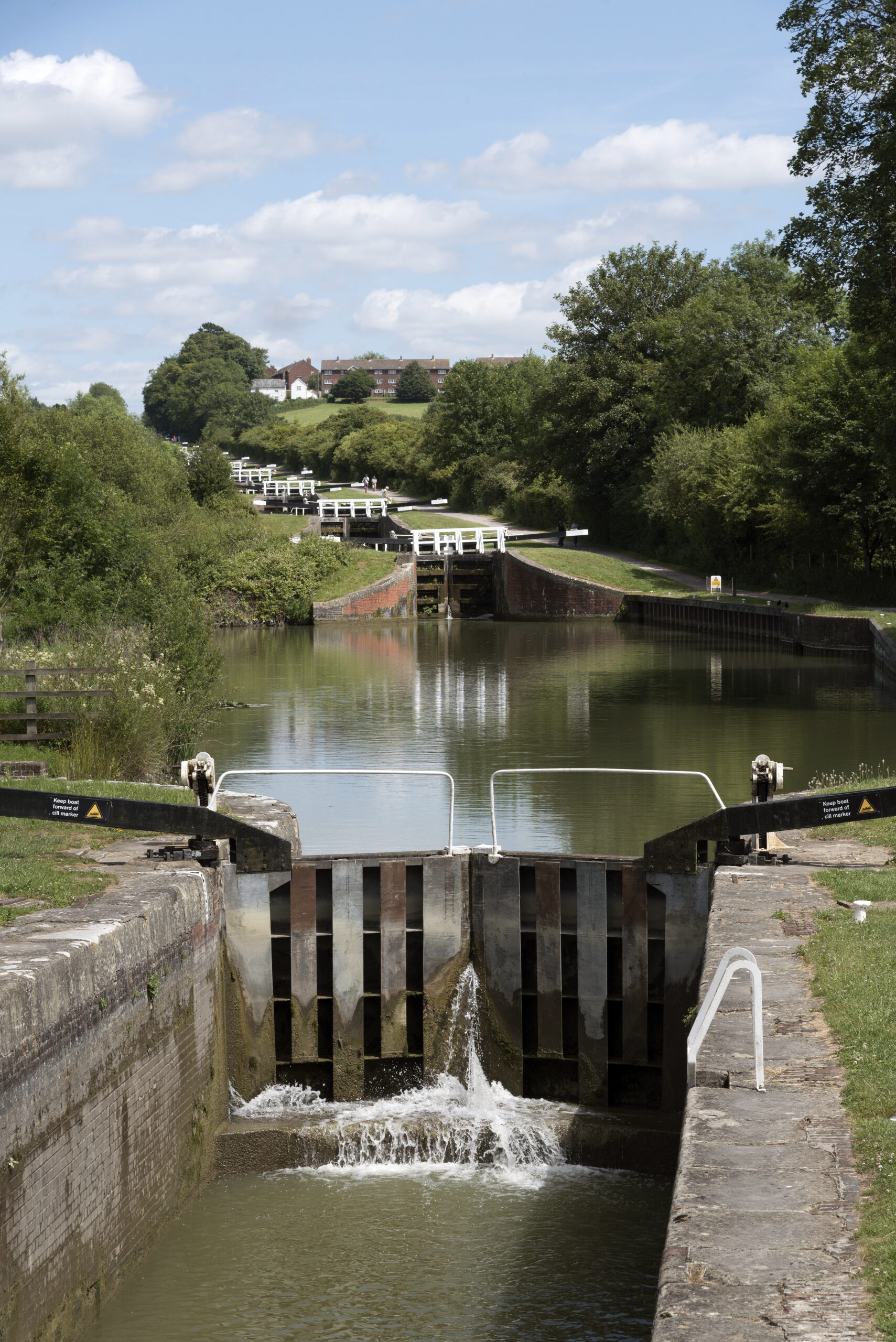
Caen Hill Locks, on the Kennet & Avon Canal near Devizes in Wiltshire, are widely regarded as one of the most extraordinary engineering features on the entire UK waterways network. The site is famous for its dramatic flight of locks rising in a straight line up the hillside, forming a staircase that has become one of the most iconic images of Britain’s industrial canal age.
A 29-Lock Climb, Including the Famous 16 in a Row
The full Caen Hill flight consists of 29 locks, stretching over roughly 2 miles. What most people recognise is the central section of 16 consecutive locks, arranged in a perfectly straight line with minimal pounds between them. This section alone accounts for a rise of about 237 feet (72 metres) and was designed to tackle one of the steepest gradients on the canal.
The layout is so steep that the pounds between the central locks are too short to hold enough water for normal lock operation. For this reason, the engineers incorporated a system of side ponds, large reservoirs positioned beside each lock to store and recycle water. This innovative design dramatically reduced the amount of water needed for each passage and made the otherwise impossible climb feasible.
Origins in the Early 19th Century
Construction began in the late 1790s under the direction of the renowned Scottish engineer John Rennie, who was also responsible for major works such as London Bridge and parts of the Lancaster and Crinan Canals. The Kennet & Avon Canal was intended to create a continuous inland route between Bristol and London, reducing the need for coastal shipping around the south coast.
The Caen Hill section was one of the greatest obstacles on the route. Rennie’s solution—this long, steep flight—was an engineering achievement that impressed even the canal builders of the time. The locks were completed in 1810, forming the final link that made the Kennet & Avon fully navigable.
Decline and Near Abandonment
With the rise of the railways in the mid-19th century, commercial canal traffic declined sharply. By the early 20th century, Caen Hill Locks fell into disrepair. By the 1950s, many of the locks had become unusable, the pounds were silted up, and vegetation had begun to reclaim the hillside. The canal was effectively abandoned and only passable in very short isolated sections.
Restoration: A Major Volunteer Effort
The revival of Caen Hill Locks became one of the central projects of the wider restoration of the Kennet & Avon Canal. Starting in the 1960s, volunteers, canal societies, and eventually British Waterways took on decades of work to rebuild, re-gate, dredge, and restore the entire flight.
One of the biggest milestones came in the late 1980s when British Waterways secured funding to complete the remaining work. In 1990, after roughly 30 years of volunteer and professional restoration, the entire Kennet & Avon Canal—including Caen Hill Locks—was officially reopened by Queen Elizabeth II. Today, it stands as one of the most successful and celebrated canal restoration projects in the country.
Caen Hill Today
The locks still operate using principles originally laid out by John Rennie. The side ponds remain an essential part of the system, helping manage the huge volume of water required to move boats through such a concentrated rise. The towpath and surroundings are maintained by the Canal & River Trust, and the flight is now both a popular boating challenge and a well-loved walking and cycling route.
Modern boaters typically take 2–5 hours to ascend or descend the whole flight, depending on traffic, volunteer assistance, and water levels. Despite heavy gates and large chambers, the locks remain a fully manual, hands-on experience—an enduring example of early 19th-century engineering still performing exactly as intended.
A Lasting Monument to Canal History
Caen Hill Locks represent more than just a functional waterway structure. They are a monument to Britain’s industrial effort, a symbol of the restoration movement’s success, and one of the clearest reminders of how ambitious and technically advanced canal engineers were over 200 years ago. Their scale, symmetry, and historical significance make them a key destination on the Kennet & Avon Canal and a highlight of the UK inland waterways.
When you click on links to merchants from the site Website and make a purchase it may lead to this website earning a commission. This does not effect the price you pay. Affiliate programs and affiliations include but are not limited to The Ebay Partner Network, Amazon, and Awin programs.